
Comic Sans: still groovy
Sometimes, a game has such an amazingly simple and effective mechanic that you wonder why you didn’t come up with it. Sword vs Poker is an example of one of these games. It can loosely be called a “puzzle-adventure” game (or, as if often the case with iPhone games, it really fits into the “timewaster” genre), where the core game mechanic is about using poker hands to defeat monsters. So far so surreal. It opens, promisingly (?) with: “this is a story of a magical world based on cards.” It’s not exactly the greatest start to a game I’ve heard, and things take a turn for the worse when you see that the entire UI is done in Comic Sans. But it’s endemic of the biggest problem with this game – the gameplay is fine, but it was assembled by people with some of the worst taste and sense of design in the entire world.

Hottest female (?) lead ever? Hell yes.
The game starts with your nameless hero (who you don’t care about in the slightest) coming up with some (meaningless) justification to fight off the (equally irrelevant) main antagonist and all his minions. Seriously, I don’t even remember who I’m fighting or why. The cutscene you have to sit through sadly isn’t really skippable and suffers from the wall of nonsense text phenomenon (much like this blog, let’s be honest), as well as the our ‘artists’ use MS-Paint syndrome. Thankfully, the creators of the game also probably realized that story and writing was never going to be their strong point, and you are mercifully dropped into the actual game component and pretty much left alone.

The mushroom yearns for human blood
The level map consists of a bunch of badly drawn monster graphics linked by a preset path. They didn’t make it a dungeon crawler, it’s just a series of discrete battles. Monsters have varying amounts of health coins and different special attacks (e.g., some monsters can make you skip your turn when they play a full house), and you wander around defeating them in turn by playing poker hands. When in battle, you are presented by a 5×5 grid of cards, the middle 9 cards are pre-dealt. You can create a poker hand out of the currently placed cards and two of the four cards in your hand by making a straight line. Any of the cards in that line are used to decide what hand you made, and from that, the damage and any special abilities of your weapon. Like I said, it’s amazingly simple, but it’s incredibly solid.

Anthony Hopkins really let himself go.
Things are mixed up a bit by equipping you (and the monsters) with different weapons, shields, and even magical powers that can drastically alter the game flow. It’s fairly well conceived, although (and perhaps I am just playing it wrong), I find that about 70% of the magic and over half the weapons are pretty much useless. The weapons that heal you or paralyse the enemy are all you’ll ever need, and I went through the game using about 4 of the 12-odd available spells. That said, the variation is largely irrelevant; each battle is pretty much equally fun once the magical abilities are unlocked. In fact, that is the game’s great issue, everything, from the small enemies to the boss battles, is basically just a repeat, made different by the random dealing of cards. Indeed, the entire second game is basically just more of the first, hell, most of the spells and equipment were just copied over.
Nevertheless, I have clocked god knows how many hours in this game. It’s perfect for playing absent-mindedly on the train or while waiting for, well, anything really. Both games are good but the second is both longer and more feature rich. I haven’t encountered any real bugs with it except for some occasional sound stuttering, and I can quite happily recommend it for people looking for something to fill the gaps in their day. Oh, and the music is rubbish — it is the Comic Sans equivalent of the Final Fantasy V soundtrack.
| Gameplay | |
| Solid, fun and challenging enough. | 6/10 |
| Art Direction | |
| Made by blind people, loses some points here. | -2/10 |
| Story and Writing | |
| Abysmal. | 0/10 |
| Sound and Music | |
| Painfully bad in many areas. | 2/10 |
| Longevity | |
| Plenty of levels that don’t really get boring. Nobody will be rushing to replay it immediately, however. | 4/10 |
| Technical | |
| No bugs, but nothing worth noting. | 4/10 |
| VERDICT: | |
|
55%
As an iPhone game, I regard this as a good and worthwhile purchase. It’s not terribly polished, but it’s a reasonable execution of a great (if simple) idea. |
|
A few days ago, I wrote (I will never say “blogged”) about my encouter with an obfuscated .NET assembly. Well, last night, I decided the have a bit of fun with it. I’ve identified what obfuscator was being used (with a view to trying it on some test assemblies), but I got frustrated when I encountered one of those “register here to try an evaluation” forms (or, “give us your email so our salespeople can stalk you”), so I’m working entirely off that single test case.
Now, .NET comes with a powerful code introspection tool, System.Reflection. Reflection is great for binding variables, enumerating properties and doing all that kind of semi-seedy stuff you tend to want. It is not, however, great at editing code. Infact, it is so un-great as to not let you do it at all. Reflection works only on loaded assemblies and is really a metadata-manipulation library. If you want to get to the IL code itself, or go around renaming things, you’re going to need a more powerful tool. Enter Mono.Cecil.
Cecil is able to load up assemblies, edit/add/remove types, methods, attributes, you name it. It’s then able to save the resultant file out with no issues. It’s an absolutely amazing library, and being entirely written in C#, it works when hosted in Mono, or just as a normal .NET reference assembly. It’s one of those incredible libraries that not only is almost ridiculously, insultingly, straightforward to use, but it is enormously powerful. So, I fired up Visual Studio 2010 (which I have an interesting relationship with at best – I think maybe Microsoft hired some Apple people to help them make VS2010), compiled the Mono libraries from the latest source dump – thank christ we’ve moved on a bit, they actually had a project file and a .sln, I didn’t even need to funroll any loops. I then made a new C# console app, added Cecil and Cecil.Rocks (apparently the Cecil people suffer from nerd humour), and managed to write a deobfuscator in about an hour and a half.
It’s not perfect, but it translated a good 90% of the functions without any issues, and the ones that Reflector still complains about look like perfectly valid CIL to me. I suppose that Reflector’s decompiler still has some flaws – and I wouldn’t be at all surprised if the obfuscation process got rid of common patterns that it looks for. Since I don’t want to scare off too many non-programmer blog readers with this, I will go into the gory details beyond this “more” button…
 It’s been three whole days since I started this blog and I have only just got around to raging on Apple products. Since this is my first mentioning of it, let me preface this with a little background. I suffer from an uncontrollable hatred of them. I just find that if when a piece of technology somehow emanates a field of utter smugness for several metres, it is very deserving of my ire. I also own an iPhone. It and I have a love/hate relationship. I mistreat it just because it is an Apple device, and yet I have it with me all the time because compared to all but the latest Android and Windows Mobile 7 phones, it’s by far the best, and most balanced portable internet gateway and gaming platform. It’s also a totally rubbish phone, but I suppose you can’t have everything. I even also have a Macbook Pro which is required for work, but I have naturally installed Windows 7 on it as I don’t wear a turtleneck.
I barely go a day without raging at an Apple product (probably because I have to actually use them every day) but given the recent news about the iPhone 4, I felt it was a good juncture to weigh in on something that has been irritating me since its release. I am speaking, of course, about:
The “Retina Display”
Apple’s marketing department has taken a leaf out of the pages of history, apparently assuming that if you tell a lie enough times, nobody is going to question it. Especially if you dress it up with a liberal dose of insufferable pretentiousness. But this, this is somehow special because it has possibly the worst case of wanky name syndrome that Apple have produced. During the same talk where Steve Jobs was telling the world how the iPhone antenna was utterly revolutionary (I suppose that saying it was “flawed and generally a bit rubbish” would have been a bad PR move – although I’m sure that the Mac fanboy hive mind would somehow spin it as being artsy and cool vs the suited, stuffy phones with functional reception), he also told his cult followers that the iPhone’s display, at 326dpi, was somehow beyond the “resolution” of the human retina, something which he quoted as 300dpi. I’ve been following a few news posts about this, because I want Apple to be totally wrong, but I think it’s time for me to weigh in with something more than mere trolling.
First, if he was talking about resolution in the non-computer-screen sense, i.e., the ability to resolve independent bits of information, Apple has a bit of a problem. People with normal visual acuity, or 20/20 vision, have the ability to resolve line pairs given a spacing of above 1 arc-minute, or 1/60th of a degree (for human vision, despite what Apple attempts to tell us, is measured in angular acuity, not dots per inch). If you do the maths, you end up at this becoming a planar resolution of about 300 pairs per inch at about a distance of a foot. Note that I didn’t say pixels, I said “pairs”. Human vision is a funny old thing and doesn’t actually work anything like a digital camera. Between your cone cells that perceive colour, you have tens more rod cells in the same central region, able to sense, with great accuracy, differences in luminance. In addition, you cells work in a very squishy, biological way, stimulating adjacent cells and causing localized feedback, which is why certain patterns, such as high contrast pairs of lines, are difficult to resolve, but high contrast step gradients are not. In short, for it to be completely unresolvable, each arcminute would need to have three pixels at a distance of 1 foot, or three times the dot pitch of the iPhone 4. This effect can also be seen with something called “Vernier Acuity”, where people with normal vision are able to align two line segments to a resolution of 0.13 arcminutes – our reconstruction of the world allows us to perceive data from our retina that is apparently beyond our physical ability to.
Next, if we’re talking about resolution in the same sense as a screen or TV, basically it’s just marketing nonsense. Bring an Phone up to your eye and you will be able to see the pixels. Humans have about 5 million cone cells arranged within some 100 million rod cells. We have a visual field (per eye) of about 160 degrees horizontal and 135 degrees vertical, with a central region of 60 degrees horizontally seen by both eyes. About the central 30 percent of our visual field sees colour, and our eyes dart about impercebtibly to fill in all the gaps. Using these numbers to come up with an aspect ratio of about 1.18:1, our cone cells have a computer-screen resolution of 2248×2058 pixels, but it doesn’t really work like that. Using the initial numbers above, dividing the visual field by the resolution, we end up with some preposterous size of around 300 megapixels. Theoretically such a display should be pretty much impossible to resolve if it covers our entire visual field, even if we have it right up against our face, but I suppose we’ll have to wait for that.
So either way you slice it, it doesn’t work. The iPhone 4 has a lovely S-IPS display with good contrast and it is very crisp, but every time I look at one I feel the urge to microwave it. I can’t help but wonder why Apple feels they have to pull this kind of nonsense all the time. I mean, when laser printers became commonplace and people could easily print at 600dpi, I don’t remember anyone trying to sell me “Retina Paper” to go with my magical new printer.
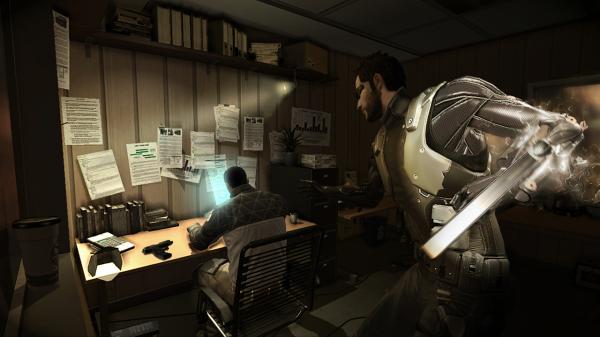 I have a confession to make – I intend to replace my usual per-post dose of rage with an equal amount of pathetic gushing. Deus Ex, one of the best games of all time, is getting a sequel (no, not another sequel – I like to pretend that Invisible War isn’t a Deus Ex game, because that way I can actually enjoy it), and not only that, but the Steam store went live yesterday, which means that I now am officially in countdown mode for the release (some 8 months off).
Deus Ex was one of those incredible games that had a confluence of brilliant facets; a convincing story, a hauntingly believable, near-future, cyberpunk setting, some great level design, and all of it was glued together with an accomplished mix of first person shooter and role-playing game. It is (rightly) held up as a pinnacle of gaming, and came from the same family of gameplay genes as System Shock and Thief: games that still to this day, 16 years on in the case of System Shock, stand their own against the best we can offer.
Deus Ex followed JC Denton, an experimental super-soldier, augmented with nanobot-based enhancements, as he uncovered a global conspiracy that threatened the entire human race. It is famous for providing a great number of viable paths to objectives, even allowing you to improvise by manipulating the environment yourself (a fancy way of saying “you could even stack boxes to get over a fence”) – something which is almost impossible to do in modern games. Go on, try it. I’ll wait. These things were not scripted in Deus Ex – it was almost like a story driven sandbox game, in that the designers set up the rules of the world and then let you get on with it. Deus Ex is even capable of recovering gracefully when the player goes off the beaten path and, for example, kills (or doesn’t kill, for that matter) a plot-critical character when the story doesn’t expect them to. It’s not just possible, it’s actually a perfectly viable strategy in the game, especially when you go through your second (or, say, twenty-second) time through with the benefit of total foresight.
I lament the death of games like that. Somehow, during the last decade, when the cost to produce a game rose from about $16.00 to tens of millions, people seemed to forget the lessons we had learned about game development. Everyone got obsessed with “streamlining”, “accessibility” and “dirty console players”. Half the first or third person games these days don’t even allow you to jump, and do you know why? No, despite what people may say about keeping the experienced “focussed”, they really mean “we are too lazy to give players the freedom to not follow the exact path we have determined.” Oh damn, I’ve started ranting again.
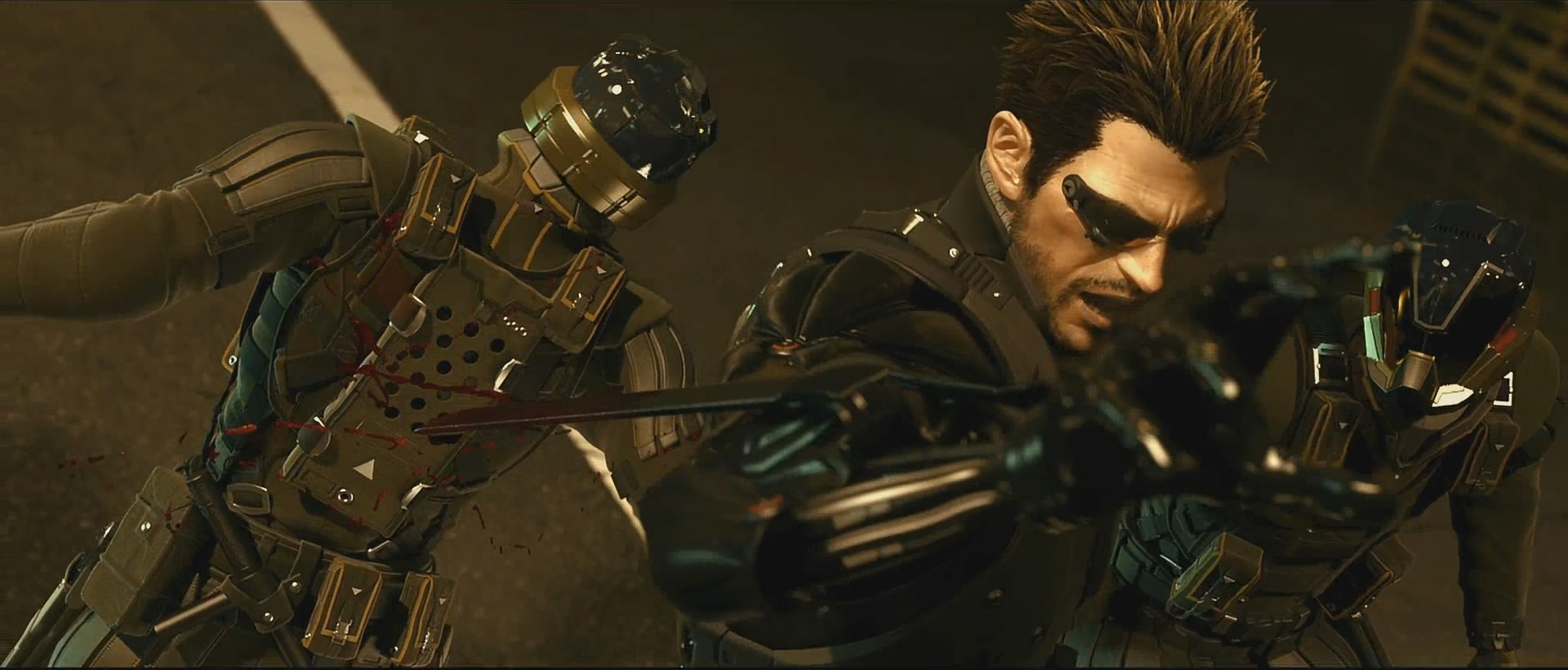 So, to Deus Ex 3, or “Human Revolution” as they’re calling it (they’ve dropped the ‘3’, maybe because it implies there was a ‘2’). Eidos Montreal is developing it, published by Square Enix, which I have high hopes for as a partnership. For a while, there was a bit of concern amongst observers when they started talking about trying to follow the costume cues from the Renaissance; their reasoning being that the dawn of post-human cybernetically enhanced society would spark a new renaissance – a fairly believable motivation, but everyone walked away with an image of a terminator in pantaloons. The lead designer also said that the original Deus Ex was “too slow” and “like a simulation”, which certainly worried me, but then he talked about how DX3 is definitely following from the steps of DX1 and leaving Deus Ex: Invisible War far behind, and we all calmed down again.
Fast forward to a month ago, at E3, and Squeenix released an amazing trailer, which I still watch about once a day. It also had some fantastic music as well, that they released a few days afterwards. Sure, it was pre-rendered, and done by Square’s prodigial cinematics department, but the development team swore up and down that it captured what they were creating. Shortly afterwards, some lunatics (who undoubtedly won’t get another invite) leaked the closed-door screening of DX3, and I officially became a hopeless fanboy. Now I just have to wait the 8 months before it gets released, assuming they don’t screw us PC gamers and just delay our version for some arbitrary amount of time.
Goodness, that sounded positively upbeat. Maybe I can even stand to read the latest thing about Dragon Age II without imploding.
“The art in Origins was a bit messy, kind of overwrought, pretty generic. So, ‘hot rod the art’ means we’re going to strip it down to the essentials and come up with a more elemental, ownable art style.”
– Matt Goldman, Art Director, Dragon Age II
“Hot rod” the god damn art? Oh sod off.
 BREAKING NEWS

Amazingly, it seems Bioware have outdone themselves yet again! Gamestar Magazine did a multipage special on Dragon Age II recently, and, amongst several things we’ve already heard before, they published this comment:
When I give a combat order in Dragon Age: Origins, I have to twiddle my thumbs waiting for the character to slowly meander into position and then start swinging its sword. This is unacceptable.
– Mike Laidlaw, Lead Designer, Dragon Age II
What on earth is he trying to say here? That all those pesky laws of physics are getting in the way? We should have teleporting characters with permanently drawn, 10 foot long swords a la Final Fantasy? I happen to like the fact that it takes actual time in the world of Dragon Age to close distance – it’s what stops mages from being squishy meat sacks and turns them into viable party members overpowered killing machines. In fact, I even like the idea that my party has to ready their weapons before charging into battle. It’s called “roleplaying“. Possibly they haven’t heard of it? It seems to be that the unacceptable thing here is that kind of attitude, from a lead designer no less.
I am actually so horrified that I need to take a step back and find out who on earth he is. It seems that he was part of the three lead designers on Dragon Age (1), and, conspicuously, he is the only “Lead Designer” who hasn’t worked on the Baldur’s Gate series (apparently, he instead worked on Bioware’s worst title to date — don’t be fooled by some of the scores, listen to some of the music to get a feel for it). Actually I guess I should take that back, Bioware’s worst title to date is probably Dragon Age: Origins – Awakening, which I actually can’t blame on him. I just don’t understand his faster = better argument; maybe because I play the game as a tactical combat game rather than a third person button mashing simulator. I truly hope he reconsiders this opinion and avoids stripping out all the non-twitch mechanics from the game, even if it will anger some of the Halo players.
I know what you’re thinking; “that magazine is in German, you probably used Google translate for this, and anyway, you’re totally overreacting to a single comment without any context”. I am, of course, guilty of all charges, although I must say I have been very impressed by Google translate. Which brings me to another excerpt from that article:
So it is not forced to play any of the images used on previous Bioware bearded sword oscillator.
– Gamestar Magazine, Referencing Dragon Age II
I guess that I am still prepared to eat my words when Dragon Age II comes out and turns out to be the second coming – nevertheless, I just wish that I didn’t end up reading things like this whenever any new DA2 info is released. Mind you, it’s hard to get worse prerelease PR than the previous game.
 Those of you who program in .NET languages hopefully know about something called “Reflector”. It’s made by a company called Red-Gate and despite having one of the most irritating automatic update requirements, is possibly my favourite tool ever. Reflector is a program that can load any .NET assembly containing MSIL instructions. So far so good, but the magic comes from the disassembler, which converts MSIL (which is, in itself, fairly readable), into totally passable C# code. Or VB.NET code, or “Oxygene” (whatever that is). It can be a little shocking to write code and find that it can be completely disassembled into a high level language, but if you think about it, it’s obviously possible – especially given the enormous amount of metadata embedded in .NET assemblies. Frankly, if you can’t deal with people stealing your precious ideas, but you don’t know how to protect them (e.g., host MSIL in your own runtime, write CLI/C++ code, whatever), your ideas are probably not worth stealing anyway.
Mind you, this little “loophole” has resulted in several companies developing “obfuscators” for .NET (they exist in Java too, but Java is a bit rubbish so who really cares). In my day to day activity, I open up many .NET assemblies, (usually to work out how to work around third party bugs through some extreme programming), but today, it was a little different – I opened up Reflector on an evaluation DLL (again, I wanted to see how fixable an issue was without the source code), and was greeted with this:
protected override void OnKeyDown(KeyEventArgs e)
{
    // This item is obfuscated and can not be translated.
}
This was a little surprising, especially as I had never seen Reflector get so upset before. I’ve seen obfuscated .NET code before, Dotfuscator, which has a cut down copy distributed with Microsoft Visual Studio, is used semi-regularly by paranoid people, and not to particularly great effect (it replaces methods, variables, and the entire private interface with unhelpful names like “a” and “b” and “aa”). The MSIL could still always get decompiled, you just lost the context of seeing what things were actually called. In this case, it was a little different. The field names and private interface was helpfully replaced with unicode characters that all looked like the “you opened a gif in notepad” block symbol, but I can deal with that. The method logic, however, was apparently impossible to decode. Naturally, the MSIL is all there and correct – you would hope so as it is required for the assembly to actually be useful, and, to be honest, MSIL is not significantly harder to read than old versions of BASIC; it’s even got line numbers for you, but nevertheless, the code in this function was poisoning Reflector’s decompiler.
.method family hidebysig virtual instance void OnKeyDown(class [System.Windows.Forms]System.Windows.Forms.KeyEventArgs e) cil managed { .maxstack 2 .locals init ( [0] int32 num) L_0000: ldc.i4 2 L_0005: stloc num L_0009: br.s L_000d L_000b: br.s L_0022 L_000d: ldloc num L_0011: switch (L_004b, L_0037, L_000b) // <-- This is here to annoy us L_0022: ldarg.0 L_0023: call instance int32 [System.Windows.Forms]System.Windows.Forms.Control::get_Width() L_0028: ldc.i4.s 15 L_002a: bge.s L_0055 L_002c: ldc.i4 1 L_0031: stloc num L_0035: br.s L_000d L_0037: br.s L_0039 L_0039: ldarg.1 L_003a: ldc.i4.1 L_003b: callvirt instance void [System.Windows.Forms]System.Windows.Forms.KeyEventArgs::set_Handled(bool) L_0040: ldc.i4 0 L_0045: stloc num L_0049: br.s L_000d L_004b: ldc.i4.1 L_004c: br.s L_0051 L_004e: ldc.i4.0 // <-- This is the ACTUAL problem L_004f: br.s L_0051 L_0051: brfalse.s L_0053 L_0053: br.s L_0055 L_0055: ldarg.0 L_0056: ldarg.1 L_0057: call instance void [System.Windows.Forms]System.Windows.Forms.Control::OnKeyDown(class [System.Windows.Forms]System.Windows.Forms.KeyEventArgs) L_005c: ret } |
I don’t expect everyone to be able to read the MSIL above, but bear with me. The obfuscator has inserted a mysterious switch statement at the start of the function, which it initially jumps right over. Then, at random points within the function, it sets a “magic” variable, jumps back to the switch, and uses the variable to jump all the way back to where it just came from. I’d like to say it was ingenious but it’s actually depressingly trivial. More interesting is that this is very close to legal C#, with one major issue – line L_004e (with cannot be reached during normal program flow) performs an operation that cannot be done in a high level language, pushing a second arbitrary value onto the virtual machine’s local stack (usually used for branching against a constant). In fact, if you open use the wonderful Reflexil plugin for reflector, you can remove the single offending instruction, and Reflector will dutifully decompile the result:
I find it interesting to see how these obfuscators work. In my opinion, they’re based on a flawed premise – much like DRM for movies: there is only so much they can do if they want their product to still work. I even question whether it’s enough to deter a layman from nicking bits of their code – I mean, you are simply annoying the people who actually use Reflector in the first place, people who (I hope) have a vague functional knowledge of MSIL. Still, it looks like this assembly was protected by a tool written by the same people who maintain Reflector itself. I wonder if perhaps it gave up a little easily for that exact reason…
Those of you who know me will also know that I enjoyed Dragon Age, a Bioware game released late last year. Infact, I enjoyed it a lot – despite me having to forgive a great deal of flaws such as the uninspired story, hamfisted MMO approach to skills, and the dreaded Bioware “branch into three” main plot design. The reason I forgave all of this was because Dragon Age tried to, and in my opinion, succeeded at being a modern take on a much older game (also developed by Bioware) called Baldur’s Gate.
Baldur’s Gate had several advantages over Dragon Age that got lost in the reinvention – a rich RPG underpinning from the Dungeons and Dragons ruleset was replaced by an in-house design which is clearly immature, the dreaded advance of consolitis and the even more damaging “casual” gamer replaced the hundreds of thousands of lines of text with five or six sentences spoken by an unconvincing voice actor and rendered in eye-melting 180pt Xbox friendly font. But they kept other things! They had a strategic, top down view a la Infinity Engine games, they had several interesting side quests, some real dialogue choices, and multiple types of sword that were almost the same! Sure, they got rid of character death (you can only die in DA if every party member kicks the bucket), and they lost the wonderfully rich setting of D&D (creating their own Tolkein rip off land), and post patching, the game was almost hilariously easy (even on the dreaded nightmare difficulty), but you could see what they were trying to do, damn it.
More importantly, it was a like they had made a promise to all of us who bought, played and loved the old school CRPGs like Baldur’s Gate (I and II), Planescape: Torment (best game ever) and Icewind Dale. The promise was “here is your chance to relive that experience, it’s not quite the same but it’s closer than anything made in the last 8 years and we’re even going to make a franchise out of this bad boy”. So we all rushed out and bought it, enjoyed it to varying degrees and told eachother “this game would be pretty good with another iteration of polishing and a bit more content”.
We should have seen the writing on the wall; Dragon Age came with the worst DLC since Bethesda made us pay actual real money for horse armour. DA’s DLC has been universally overpriced, under-specced and half-baked. The “Warden’s Keep DLC” which came out with the game and promised hours of excitement as you discover the secrets of your warrior order turned out to basically be three rooms, some game breaking items and two utterly useless skills. It was followed by the even worse Return to Ostagar, and several other wastes of time and money. The proverbial knife was really twisted when the expansion pack, Awakenings, was released. I played Awakenings just because I felt I owed it to the story (and my wallet) to do so. Your party members who you developed a relationship with (a hot lesbian relationship, in my case) in the main game got replaced by a bunch of shallow automatons, who somehow rip off characters from the actual game itself. The side quests are watered down, the conversations pared back, and the whole thing really feels like a bit of a cheap buck, undoubtedly the case, given its amazingly short development time.
Which, finally, takes us to Dragon Age II, of which press releases came out a few days ago. To my abject horror, they’re doing what I absolutely wanted them not to – they’re “streamlining” it. The main character is now going to be fully voiced, which always means fewer conversations, less dialogue, less customization. The whole real-time-turn-based pause mechanic of the old game is gone (perhaps for consoles only), apparently it was too hard for the legions of Halo players who bought the first game (which sold better than any other Bioware game to date), so they’re going for a more god of war style combat system (I assume). The dialogue system is being ripped from Mass Effect (you pick a summary of what you want to say rather than choosing some text from a list) which doesn’t really bother me, but it seems to me like they’re trying to merge Dragon Age and Mass Effect to streamline development and appeal to an audience with less developed higher order brain functionality. The lead writer has even said that he wants to remove the ability to talk to your party members (probably too expensive) about their lives – with the exception of Knights of the Old Republic / Dragon Age: Awakenings style “contextual” dialogue. Literally the only way to learn anything about the characters in Awakenings is to drag the correct party member to the correct place and click on some random object such as a tree or a statue that somehow gets them into a chatty mood. They’ve even reduced the amount of character customization allowed.
Thankfully, a great many people have responded to the news in much the same way – begging Bioware not to create “Dragon Effect” as it is now known. I don’t understand it, maybe I’m just naive, but if the original sold so well, why mess with the formula? My girlfriend is a huge Dragon Age fan, and she isn’t even a serious gamer, yet when I tell her the news from the press releases she is horrified at the planned changes. Unfortunately for all of us, DA 2 is due for release in 8 months, not enough time for a major redesign. Of course, there are some people who have applauded the changes, people who should be shot on sight, but they bought the original game anyway, so it can’t have been that bad.
And now for the title of this post. With the press release they released one of the most atrocious screen shots I have ever seen. It literally made my eyes fall out of my head and explode. People complained about the art style in Dragon Age (zoomed out, the way awesome people play it, it looks fine, if a bit uninspiring. I assume the people who complained were console gamers and therefore not really worthy of consideration), so the geniuses as Bioware have gone for a more “anime styled”, “cleaner” look. See the before and after below:


I wonder if they’re trying to make it work on the Wii…
Actually, I’ve been meaning to have one for a while. On and off, that is. In my advancing years I have gradually learned to really not take THE INTERNET too seriously, so basically, if you find anything I post here interesting, good for you. If you don’t, well, I guess not everyone is awesome.
So what is this blog about anyway? In my mind, I have decided it should be a vehicle for me to discuss my major interests in life: cooking, computer games, programming and hating on things. It’s hard to say how these things will actually turn out, especially given my prior abortive attempts at some form of blog, but in this one, I hope to up the survivability by widening the allowed topics (i.e., to “whatever”). Who knows, I might even write something that someone may actually find interesting one day.
For anyone who has actually got this far, I’m a professional games programmer in Melbourne, Australia. I have worked on multiple titles that actual real people have played, and I am a highly opinionated, outspoken and generally vaguely angsty person. I also enjoy cooking. I apologize in advance for my eclectic mix of posts, but I promise to use the tags judiciously to assist you in finding useful ones.
 Eat/Play/Hate